


If I could sit down with every homeowner before a project starts, I’d say this first. The groundwork is the work. Land clearing and proper site prep do not feel exciting, and they definitely do not look exciting in photos. But they decide almost everything that happens next.
And because we handle Kansas City foundation repair solutions every day, we see what happens when the site wasn’t prepped right. Not in a dramatic, once-in-a-lifetime way either. In the normal, slow, expensive way. Cracks that keep reappearing. Doors that suddenly start sticking again. Basement walls that begin to bow. Water that won’t stay out even after someone “fixed drainage.”
Most of that story starts earlier than people think. It starts with how the land was cleared, graded, compacted, and managed before concrete ever showed up.
What land clearing actually means (and what it should include)
When people hear “land clearing,” they picture trees coming down and brush getting hauled off. That’s part of it, sure. But for a build site, an addition, a detached garage, or even a major yard rework, land clearing should be treated like a foundation related step, because it is.
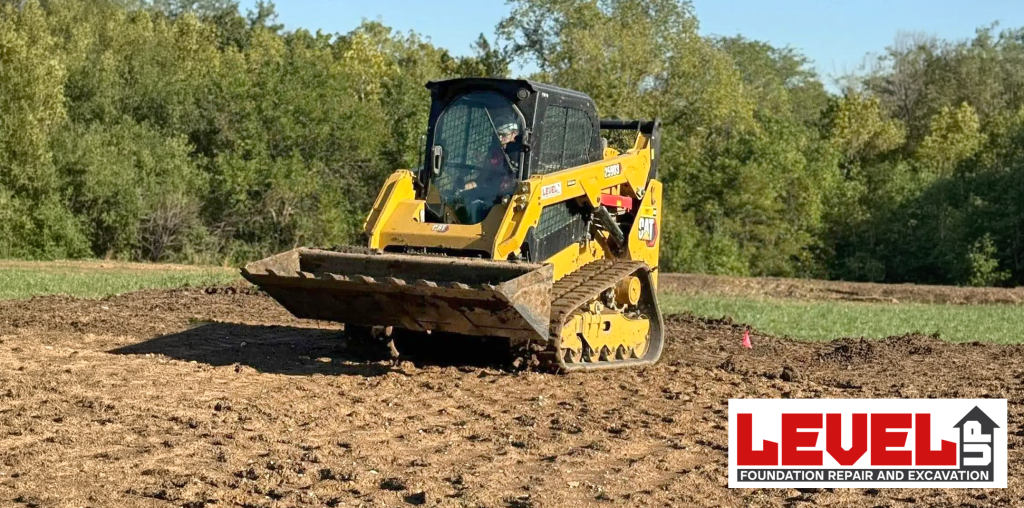
I look at land clearing as removing what shouldn’t be there, and preparing the soil so what you build later actually stays put. That includes things like pulling stumps and major roots, stripping organic topsoil where needed, removing buried debris, and making sure we are not leaving behind soft pockets that will settle after the slab is poured or after the first wet season.
One of the most common problems we see later is a spot that was “good enough” during clearing. A filled area where loose soil was dumped and lightly smoothed over. It may look fine for months. Then the soil consolidates, water finds the easiest path, and the structure above starts telling the truth.
That’s why it’s crucial to hire professionals for land clearing who understand these nuances and can ensure that your site is properly prepared from the very beginning.
Site prep is where drainage either gets solved or guaranteed to fail
In our world, water is usually the main villain. Not just rain. I’m talking about runoff patterns, downspout discharge, saturated clay, and the way Kansas City area soils hold moisture and swell. If site prep ignores water management, foundation repairs become more likely down the road.
Proper site prep is where we shape the land, so water moves away from the home, not toward it. It’s where we plan for slope, swales, and runoff routes that still work after landscaping settles. It’s where we decide if we need to bring in structural fill, and how to compact it in lifts so it acts like ground, not like a sponge.
If I had to boil it down, I’d say this. If water can sit near your foundation, it will. And if it sits long enough, it will eventually show up inside the basement or in the form of movement.
Compaction is the quiet step that controls future settling
People love talking about concrete strength and rebar patterns. Those are important, but the soil under the concrete is the part that gets ignored.
When we prep a site, the goal is stable support. That means compaction done correctly, not just driven over a few times with equipment. It means paying attention to moisture content, to lift thickness, and to transitions between native soil and fill soil. It means not burying organics and hoping they never decompose. Because they will.
I’ve walked properties where an area was backfilled after utility work, then a walkway or driveway was poured right over it. Later, the slab drops, water runs back to the house, and now we are discussing foundation movement and water intrusion that feels “random” to the homeowner. It wasn’t random. It was predictable.
Clearing too close, or leaving the wrong things behind, can create long-term issues
There’s also a simple reality. Trees and roots change soil moisture. Removing them can change soil moisture, too.
If a big tree was pulling water from the soil for decades, and it’s removed during clearing, the soil can begin holding more moisture than it used to. In expansive clay, that can mean more swelling. On the other side, leaving aggressive roots close to the structure can keep disturbing the soil and can mess with drainage.
I’m not here to say every tree needs to go. Not at all. I’m saying land clearing needs a plan that respects the building footprint, the drainage plan, and the soil behavior. When it’s rushed, we end up repairing symptoms later.
The foundation problems we see that often trace back to site prep
When we inspect homes around Kansas City, we see patterns. They show up in older homes, newer homes, and everything in between.
Here are the issues that often have site prep written all over them:
- Uneven settling that shows up as stair step cracks in brick, drywall cracking, and floors that feel sloped
- Water intrusion that keeps returning because the exterior grade is wrong, downspouts dump at the wrong spot, or runoff is being funneled toward the foundation
- Bowing or leaning basement walls where hydrostatic pressure builds because water is trapped near the home
- Driveways, patios, and walkways are sinking and then creating a negative slope that sends water back to the foundation
And what’s frustrating is that homeowners often spend money on “the fix” without addressing the cause. A patch inside the basement. Another coat of waterproofing paint. A new downspout extension that still drains into a low area. It can feel like whack-a-mole.
To avoid these recurring issues, it’s crucial to understand how proper digging prevents foundation issues. This understanding should be an integral part of any land clearing or site preparation plan.
What I recommend homeowners ask before a project starts
If you’re planning a build, an addition, or major outdoor work, I’d rather you ask annoying questions up front than pay for structural repairs later. A good land clearing and site prep crew won’t be offended. They’ll appreciate that you care.
These are the questions I’d ask if it were my own property:
- Where is water going to flow after the job is done, and what slope are we leaving around the structure?
- Are we removing organics, stumps, and buried debris, or are we just covering them?
- If fill is being brought in, what type is it, and how is it being compacted?
- What happens at transitions like utility trenches, driveway edges, and backfilled areas?
- After the first heavy rain, what is the plan if we see pooling near the house?
That last one matters. Because even when everything is done right, the first big rain is the real test. The difference is whether someone planned for that and is willing to fine-tune grading before the problem becomes permanent.
How this ties into our work at Level Up Foundation Repair
When someone calls us about cracking, settling, or a wet basement, we don’t just jump to a one-size-fits-all solution. We look at the whole system. Soil, drainage, grading, and the way the structure is responding.
Sometimes the best foundation repair plan includes exterior corrections first, because stabilizing a foundation while water keeps saturating the soil is like changing a tire while the car keeps rolling. It’s not that repairs can’t work. It’s that the results last longer when the site conditions are handled too.
We’re proud to be part of the Kansas City foundation repair solutions homeowners trust, and we take it seriously when someone lets us diagnose what’s really going on.
Ready to talk through your property and your next step?
If you’re seeing cracks, uneven floors, sticking doors, water in the basement, or you’re planning land work and want to avoid future foundation headaches, let’s talk it through. Call Level Up Foundation Repair in Odessa, MO at (816) 230-0101 and we’ll help you figure out what’s happening, what matters most, and what a real fix should look like.