

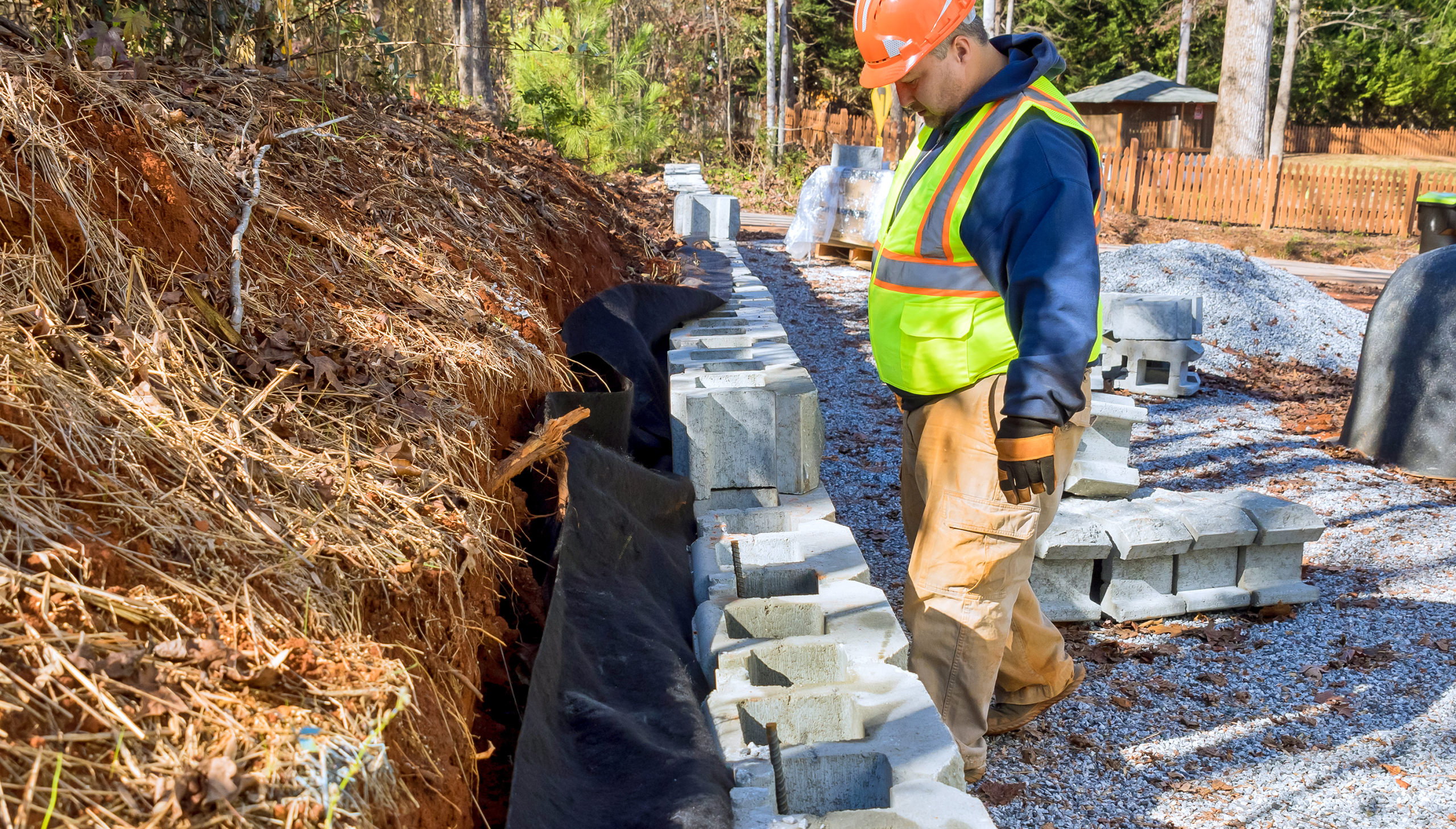
I get why retaining walls end up on the weekend project list. A few trips to the landscape supply yard, a stack of blocks, some crushed rock, and it feels like a clean, satisfying upgrade. But after years of helping homeowners around the Kansas City area deal with settling, bowing, cracked masonry, and water problems, I can tell you the part that makes or breaks a retaining wall usually happens before the first block is ever set.
It’s grading. Every time.
When the ground around a home or a wall is sloped the wrong way, water does what it always does. It follows gravity, heads to the lowest point, and hangs out right where you do not want it. Behind a retaining wall. Along a foundation. Under a slab edge. Then people call us because they’re seeing stair step cracks, leaning wall sections, gaps opening up, or that musty basement smell that shows up after a heavy rain and never really leaves.
At Level Up Foundation Repair, we treat grading as step one because it’s the easiest thing to ignore and the hardest thing to outmuscle later.
The most common retaining wall mistake I see
A lot of DIY retaining walls fail for the same reason. The wall was built like it’s holding back dry dirt, but the dirt was never going to stay dry. Soil is basically a sponge. Clay heavy soils are even worse because they expand when they’re wet and shrink when they dry out. That movement creates pressure cycles. Add trapped water behind the wall, and you get hydrostatic pressure, which is just a fancy way of saying water starts pushing like a hydraulic jack.
Even a “small” wall can get bullied by water. Once water gets behind it, that pressure works on every joint, every course, every little imperfection. The wall may look fine for a season. Then one spring, you notice the top cap isn’t straight anymore. Or the middle starts to belly out. Or you get a washout at the base. The wall didn’t suddenly become weak; the site prep was never controlling water.
So when I hear, “It’s only a three-foot wall,” I still go right back to grading and drainage.
And if things go south despite your best efforts? Well, that’s where we come in with our expertise in repairing or replacing retaining walls.
Why does grading come before drainage rock and pipes
People jump to the drainage pipe first. I get it, it feels like the “pro move.” But grading decides whether your drainage system is helping or just trying to survive.
If your yard funnels water toward the wall, you’re feeding it. If downspouts dump nearby, you’re feeding it. If the soil in front of the wall slopes toward the wall, you’re feeding it. Then that French drain, gravel column, and weep holes are working overtime, and overtime never lasts forever.
Good grading reduces the amount of water that even reaches the wall. Then your drainage details can do what they’re supposed to do, which is handle the leftovers.
Here’s the mental picture I use with homeowners. If you’re standing behind your wall and it rains hard, where does the water want to go? If the answer is “right toward the wall,” you’re building a dam, not a retaining wall.
What “proper grading” actually means in real yards
Proper grading is simple, but not always easy. You’re shaping the surface so water sheds away from structures and away from places where it can collect.
Around homes, I like to see the soil fall away from the foundation for the first several feet. Not a dramatic slope that looks weird, just enough that water doesn’t sit and soak at the edge. Around retaining walls, I want the area behind the wall to avoid becoming a catch basin. That might mean creating a gentle slope that moves surface water to the side, toward a swale, or to a spot where it can drain without loading the wall.
And one more thing that gets missed a lot. The grade needs to stay that way over time. Loose backfill settles. Mulch washes. Edging gets raised. Flower beds get topped off. A yard that drained fine right after the wall was built can quietly turn into a water trap two years later.
If I’m walking a property and I see water staining, eroded channels, or soil pulled away from the top of the wall, I already know the story. Water has been taking the same path every storm.
The retaining wall “stack” that works when grading is right
When the grading is handled first, the wall build becomes more predictable and a lot less risky. I’m not going to turn this into a step-by-step install guide, but the successful walls usually share the same backbone:
- A solid, compacted base that’s set level and below grade where it needs to be
- Free-draining gravel behind the wall, with a functioning drain path that actually has somewhere to discharge
That’s it. Not glamorous. Just the fundamentals, done cleanly. And once you do those right, you can focus on the stuff homeowners care about, like straight lines, clean caps, and matching the look of the house.
How grading problems show up as foundation problems
This is the part a lot of people don’t connect. A retaining wall is often built near a driveway, patio, garage edge, basement wall, or the side yard that already has drainage challenges. If grading directs water toward the wall, it can also be directing water toward the home.
That’s when we start seeing the bigger symptoms:
Cracks in foundation walls that widen over time. Basement leaks that only happen during heavy rain, then become more frequent. Concrete slabs that settle at corners. Doors that stick in spring and loosen in late summer. The patterns vary, but the common thread is moisture changing the soil support under and around the structure.
In the Kansas City region, we deal with real swings in wet and dry conditions. That cycle can be rough on foundations. If the grading is wrong, you’re basically amplifying those swings right where your home needs consistency.
A quick self-check before you build this weekend
If you’re planning a wall, I’d rather you spend an extra hour on a self-check than spend the next few years fighting a wall that keeps moving. Walk the area after a rain if you can. Watch where the downspouts discharge. Look for areas where water ponds or where the soil looks constantly dark and damp. Pay attention to whether the ground naturally slopes toward the spot where you want the wall.
If you’re not sure, that’s normal. Grading can be subtle, especially in side yards and landscaped areas where everything looks “flat enough” until it rains hard. Proper digging prevents foundation issues, so make sure to keep that in mind.
The bottom line
If you take one thing from this, it’s that retaining walls don’t usually fail because the block was bad or because you didn’t use enough adhesive. They fail because water was allowed to collect and push. Proper grading keeps water from becoming the boss of your project, and it protects more than the wall. It protects your foundation, your flatwork, and your peace of mind every time the weather turns.
If you’re seeing a wall starting to lean, cracks forming nearby, water showing up where it shouldn’t, or you just want a second set of eyes before you start moving dirt, call us. At Level Up Foundation Repair in Odessa, MO, we provide Kansas City foundation repair solutions and practical guidance that prevent bigger repairs later. Reach us at (816) 230-0101, and let’s get your grading and your plan dialed in before the next storm tests it.
Also, if you’re considering adding features like a backyard pond, remember that professional excavation matters.